
Einstein field equations
Tensor equations linking spacetime geometry to matter-energy.

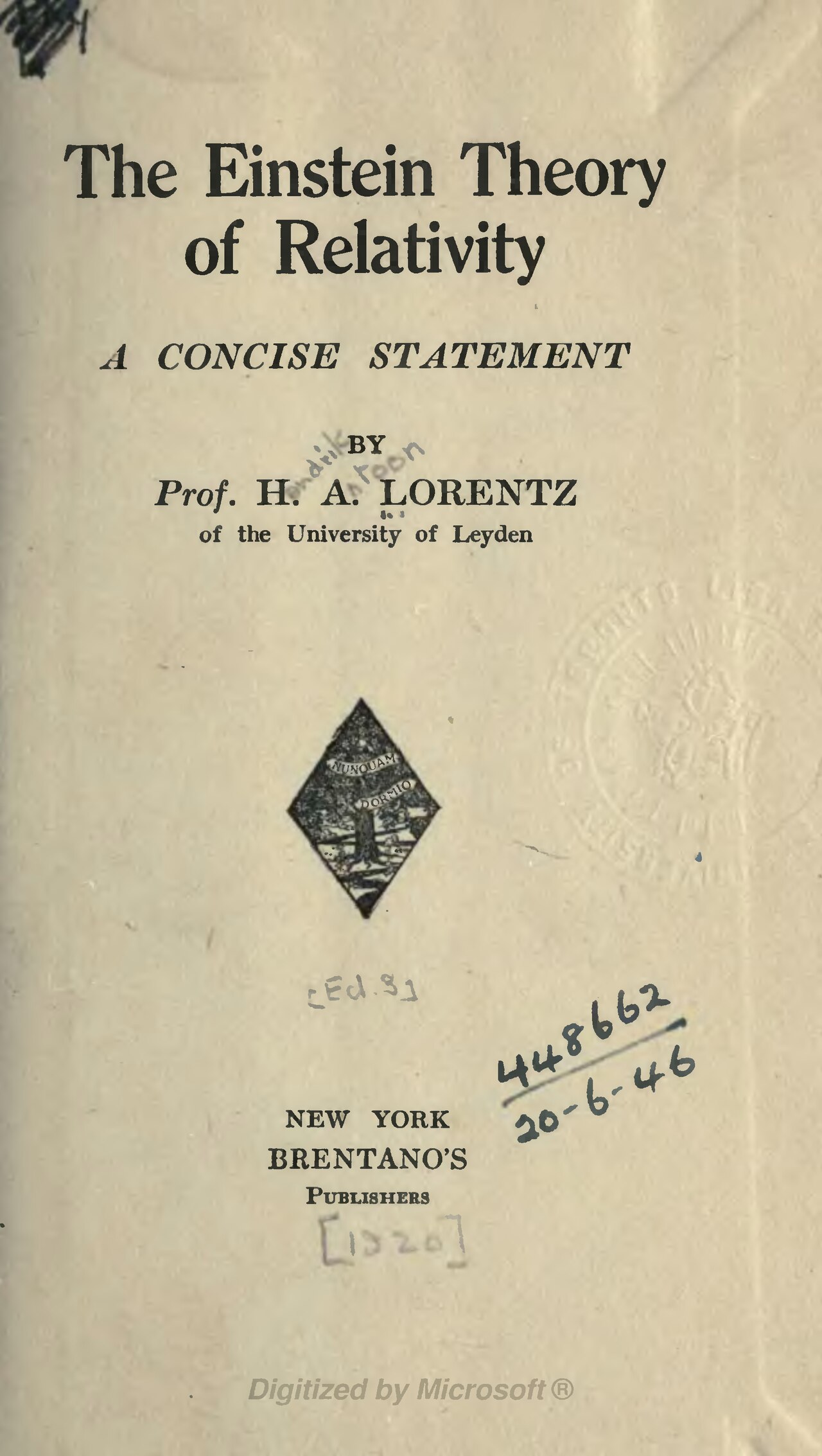
Hendrik Lorentz · Public domain
The Einstein field equations (EFE), also known as Einstein's equations, are a set of tensor equations in the general theory of relativity that relate the geometry of spacetime to the distribution of matter-energy within it. Published by Albert Einstein in 1915, they form the core of the mathematical formulation of general relativity, determining the metric tensor of spacetime for a given arrangement of stress–energy–momentum.
- field
- General relativity
- known_for
- Relating spacetime curvature to mass-energy distribution
Lore & Background
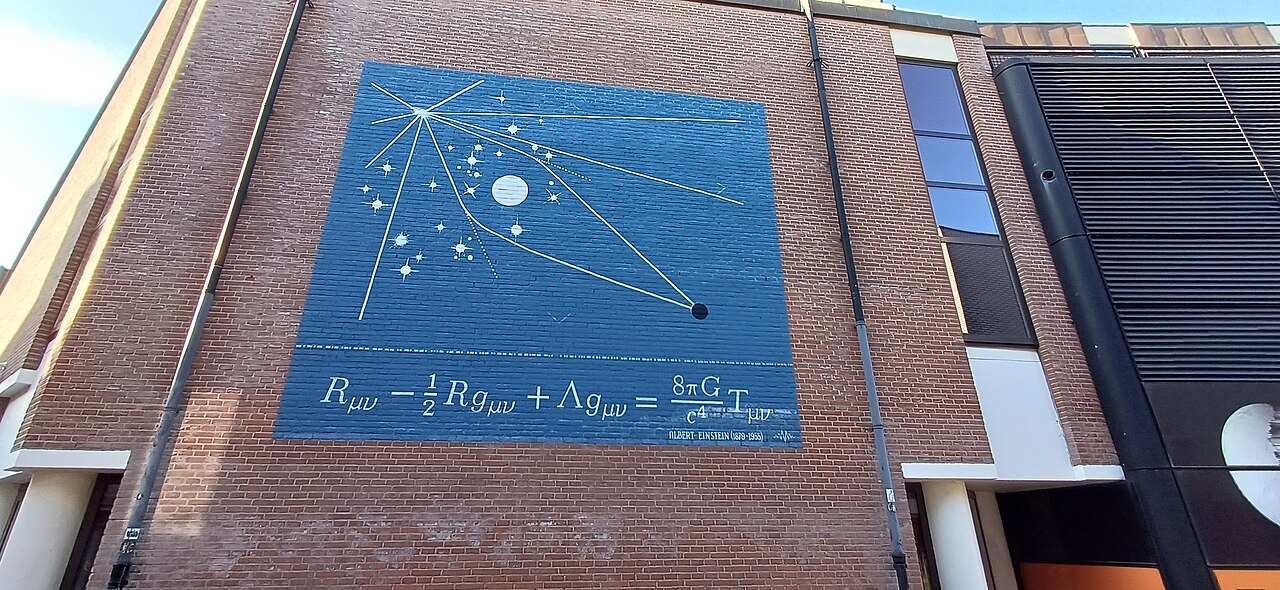
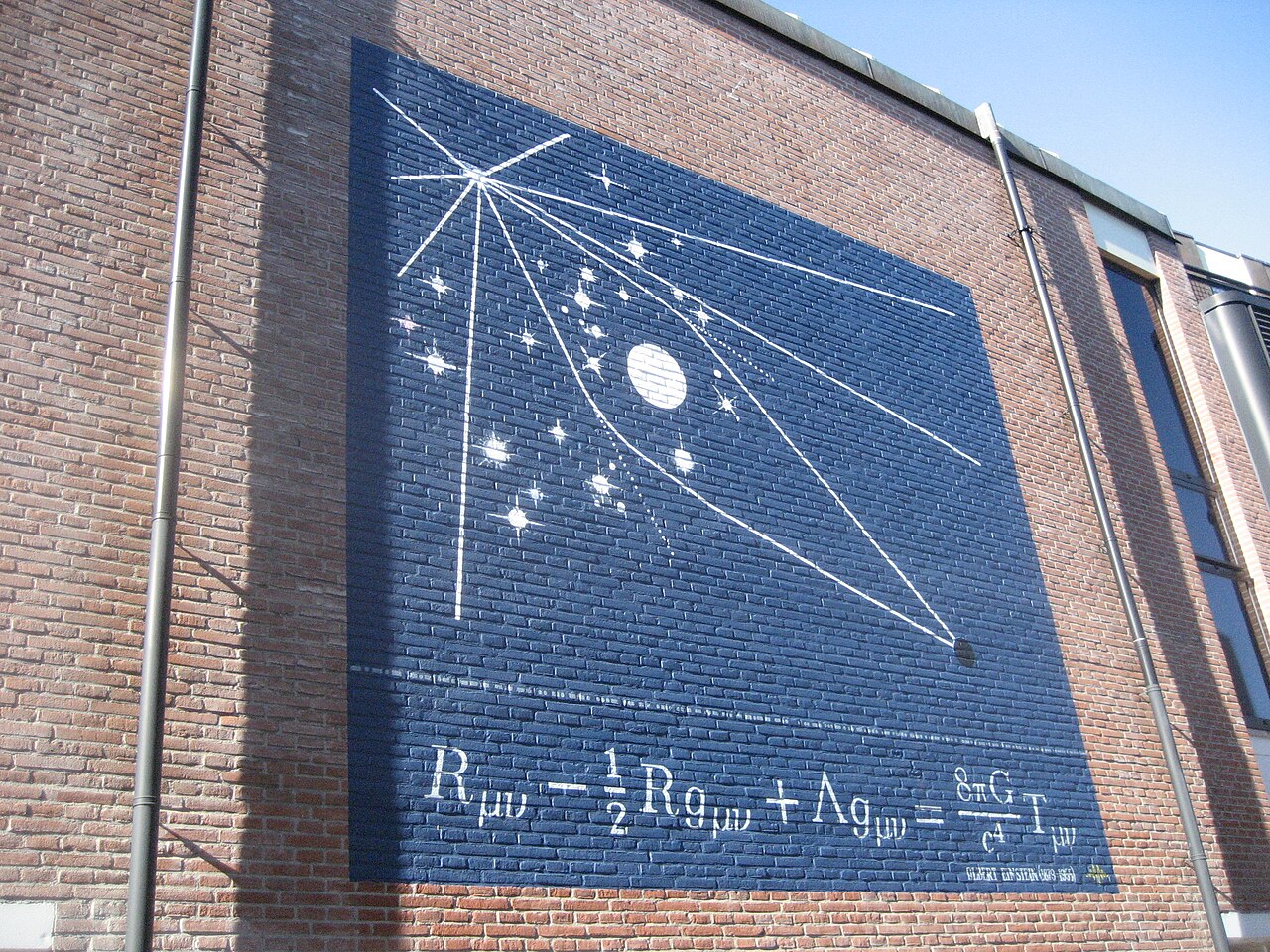
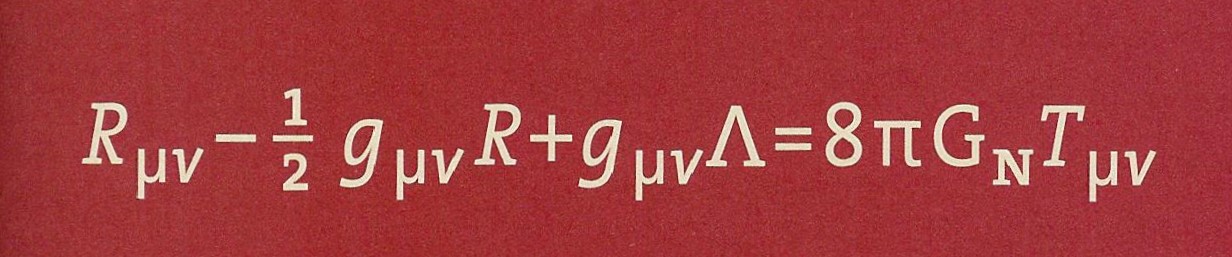
The Einstein field equations were published by Albert Einstein in 1915 in the form of a tensor equation. They relate the local spacetime curvature, expressed by the Einstein tensor, with the local energy, momentum and stress within that spacetime, expressed by the stress–energy tensor. The equations can be written as G_μν + Λ g_μν = κ T_μν, where G_μν is the Einstein tensor, g_μν is the metric tensor, T_μν is the stress–energy tensor, Λ is the cosmological constant, and κ is the Einstein gravitational constant. The Einstein tensor is defined as G_μν = R_μν − 1/2 R g_μν, where R_μν is the Ricci curvature tensor and R is the scalar curvature. The EFE reduce to Newton's law of gravitation in the limit of a weak gravitational field and velocities much less than the speed of light. Exact solutions require simplifying assumptions such as symmetry, and special classes of exact solutions model phenomena like rotating black holes and the expanding universe.
Reader's Guide
The Einstein field equations are of central significance to general relativity, as they dictate how stress–energy–momentum determines the curvature of spacetime. They are a tensor equation relating a set of symmetric 4 × 4 tensors, each with 10 independent components, though the four Bianchi identities reduce the number of independent equations to 6, leaving the metric with four gauge-fixing degrees of freedom corresponding to coordinate choice. The equations are nonlinear partial differential equations, and when fully written out, they form a system of ten coupled, nonlinear, hyperbolic-elliptic partial differential equations. The EFE imply local energy–momentum conservation and readily imply the geodesic equation, which dictates how freely falling test objects move through spacetime. In contexts outside of general relativity, the equations are still referred to as the Einstein field equations, and some theorists have explored their consequences in n dimensions. The vacuum field equations, obtained when the stress–energy tensor is everywhere zero, define Einstein manifolds. The linearized EFE, which approximate spacetime as having only small deviations from flat spacetime, are used to study phenomena such as gravitational waves.
Did You Know?
- The Einstein field equations were published by Albert Einstein in 1915.
- The equations relate the local spacetime curvature (Einstein tensor) with local energy, momentum and stress (stress–energy tensor).
- The EFE reduce to Newton's law of gravitation in the limit of a weak gravitational field and velocities much less than the speed of light.
The Physical Idea: Geometry Meets Matter
The Einstein field equations, introduced by Albert Einstein in 1915, express one of the deepest ideas in modern physics: the shape of spacetime is not a fixed stage but a dynamic entity shaped by whatever energy, momentum, and stress inhabit it. In tensor form, the equations link the local curvature of spacetime, captured by the Einstein tensor, to the local distribution of mass-energy and momentum, encoded in the stress-energy tensor. This pairing draws a natural parallel to Maxwell's equations, which tie electromagnetic fields to the arrangement of electric charges and currents. In the Einsteinian picture, specifying the stress-energy-momentum content of a region determines the metric tensor that describes the geometry of that region. Because the metric and the Einstein tensor are related through nonlinear dependencies, the field equations take the form of a set of nonlinear partial differential equations. Their solutions are precisely the components of the metric tensor. Once that geometry is known, the inertial paths of freely moving particles and light rays, called geodesics, follow from the geodesic equation, completing the picture of how matter tells spacetime how to curve and curved spacetime tells matter how to move.
The Mathematical Architecture
The standard form of the field equations reads G-μν plus Λ g-μν equals κ T-μν, where each symbol carries precise geometric or physical meaning. The Einstein tensor is constructed from the Ricci curvature tensor and the scalar curvature, specifically as the Ricci tensor minus one-half the scalar curvature times the metric tensor. It is a symmetric, divergenceless second-rank tensor that depends solely on the metric and its first and second derivatives. In standard units every term on the left-hand side carries dimensions of inverse length squared. The left side encodes the curvature of spacetime as fixed by the metric; the right side encodes the stress-energy-momentum content. Structurally, the equations relate symmetric four-by-four tensors, each possessing ten independent components. The four Bianchi identities trim the independent equations from ten down to six, leaving four gauge-fixing degrees of freedom that reflect the freedom to choose a coordinate system.
Solutions, Limits, and Observable Phenomena
Because the field equations are nonlinear, exact closed-form solutions are accessible only when one imposes simplifying assumptions, most commonly symmetries of the spacetime under study. The special classes of exact solutions that result are the workhorses of gravitational physics: they model rotating black holes, the large-scale expansion of the universe, and other idealized configurations that nonetheless capture essential features of real gravitational systems. When the full nonlinear structure is too demanding, physicists turn to the linearized field equations, in which spacetime is treated as having only small departures from flat Minkowski geometry. This approximation is the natural tool for studying gravitational waves, ripples in the curvature that propagate outward from accelerating masses. The equations also carry an important consistency check: they imply local conservation of energy and momentum. In the limiting regime of a weak gravitational field and particle velocities far below the speed of light, the field equations reduce smoothly to Newton's law of universal gravitation, confirming that the older theory is recovered as a special case of the broader relativistic framework.
Theoretical Role and Broader Significance
The Einstein field equations sit at the very heart of the mathematical formulation of general relativity. They are not merely one equation among many; they are the governing relation from which the entire geometric description of gravity flows. From them, the geodesic equation falls out naturally, dictating the trajectories that freely falling test particles and rays of radiation trace through the curved spacetime they inhabit. This means that the motion of planets, the bending of starlight, and the orbits of binary pulsars are all consequences of solving for the metric and then reading off the geodesics. The nonlinear character of the equations means that gravity gravitates: the energy stored in the gravitational field itself contributes to the curvature it produces, a feature with no counterpart in Newtonian theory. The equations were published in 1915 and have since become the foundational framework for understanding black holes, cosmological expansion, gravitational radiation, and the large-scale structure of the universe. Their tensor formulation ensures that the physics is independent of any particular coordinate choice, a requirement that the four remaining gauge degrees of freedom explicitly encode.
Gallery
Frequently Asked Questions
Who created the Einstein field equations?
Albert Einstein published them in 1915 as the central mathematical statement of his general theory of relativity. They were the culmination of years of work to reconcile Newtonian gravity with the framework of special relativity.
What do the Einstein field equations actually say?
They are a set of tensor equations that connect the curvature of spacetime to the distribution of mass, energy, and momentum within it. In plain terms, they encode the idea that matter tells spacetime how to curve, and that curvature in turn guides how matter moves.
What role do the Einstein field equations play in general relativity?
They serve as the core governing equations of the theory, determining the metric tensor (the shape of spacetime) once you specify the stress-energy content. Without them, general relativity would lack the predictive engine that produces phenomena like gravitational lensing and black holes.
Why are the Einstein field equations important to physics as a whole?
They replaced Newton's inverse-square gravitational law with a geometric description, weaving gravity into the very structure of space and time. Every modern prediction in gravitational physics, from GPS clock corrections to the detection of gravitational waves, ultimately traces back to these equations.
How does the story of the Einstein field equations end, or where do they stand today?
They remain the foundational equations of classical gravitational theory and have never been superseded within their domain. Their ongoing story involves active research into quantum gravity, where physicists seek to reconcile them with the quantum mechanical framework.
More in Relativity And Gravitation 1-20
Spotted an error? Know more?
This is a living reference — every entry is fact-audited, and reader corrections feed straight into our audit queue. Suggest an edit · See this site's audit record