
Gravitational potential
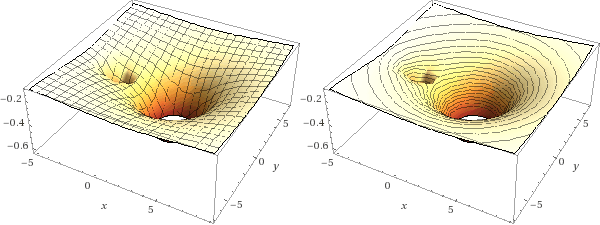
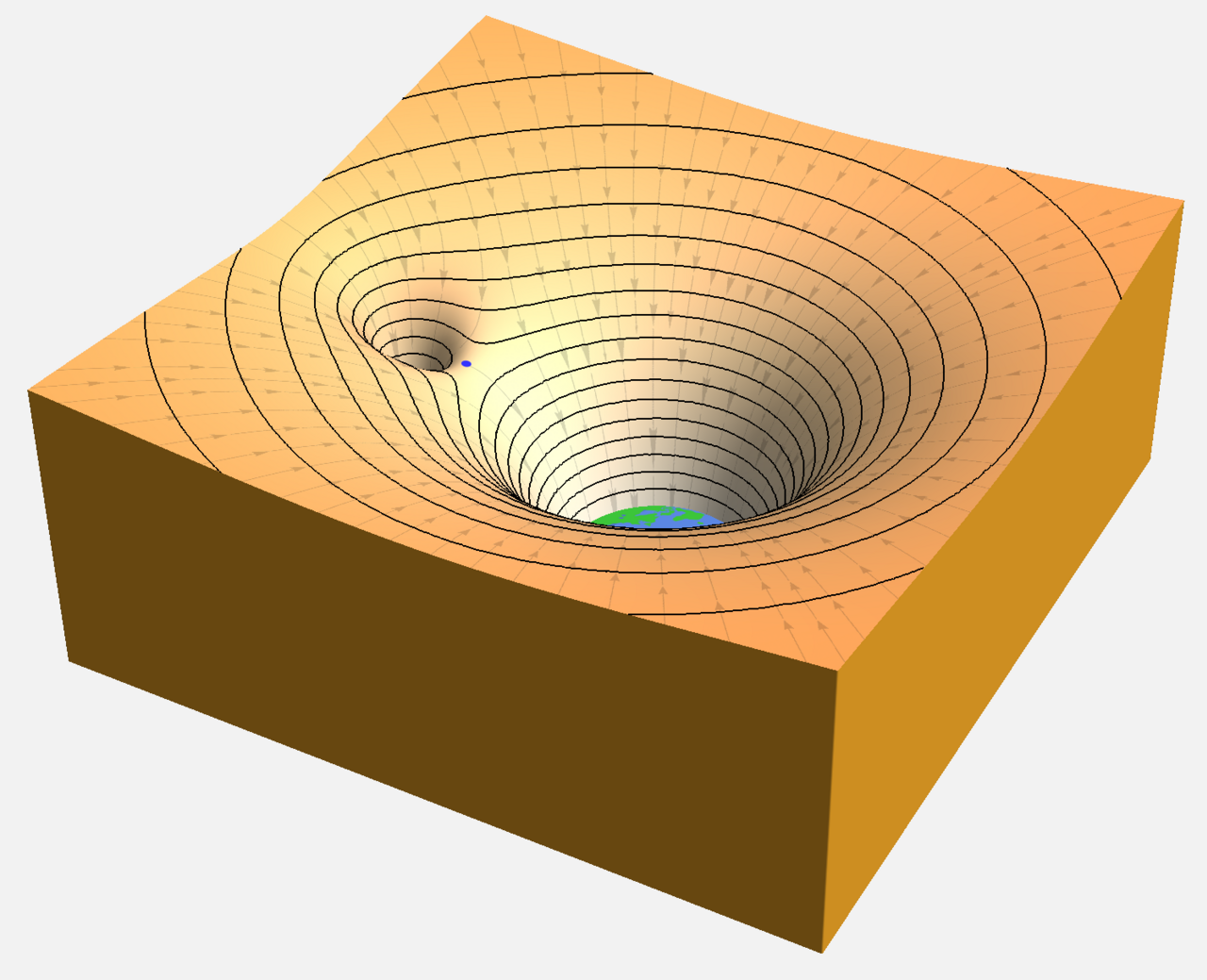
Scalar potential representing work per unit mass in a gravitational field.

MikeRun · CC BY-SA 4.0
Gravitational potential is a scalar potential in classical mechanics that associates with each point in space the work per unit mass needed to move an object to that point from a fixed reference point in a conservative gravitational field. It is analogous to the electric potential, with mass playing the role of charge, and is fundamental in the study of potential theory.
- field
- Classical mechanics, potential theory
- known_for
- Defining the gravitational potential as work per unit mass, inverse-square law acceleration, superposition principle for mass distributions
Lore & Background
The gravitational potential is defined mathematically as the work done by an external agent to bring a unit mass from infinity to a given point. By convention, the reference point where potential is zero is infinitely far away, resulting in a negative potential at any finite distance. For a point mass M, the potential at distance x is V = -GM/x, where G is the gravitational constant.
Reader's Guide
The gravitational potential is significant because it provides a scalar field from which the gravitational field and acceleration can be derived via the negative gradient. This yields the inverse-square law for acceleration: ||a|| = GM/x². The potential also obeys superposition: for a collection of point masses, the total potential is the sum of individual potentials. In regions near Earth's surface where gravity is nearly constant, potential energy difference simplifies to ΔU ≈ mgΔh. The concept extends to continuous mass distributions via volume integrals of density, making it essential for solving electrostatic and magnetostatic fields generated by uniformly charged or polarized ellipsoidal bodies.
Did You Know?
- The gravitational potential is always negative where defined, approaching zero as distance tends to infinity.
- The gravitational field is the negative gradient of the gravitational potential.
- The potential for a point mass is V = -GM/x, where G is the gravitational constant.
- The potential of a mass distribution is the superposition of potentials of point masses.
Defining the Concept and Its Physical Meaning
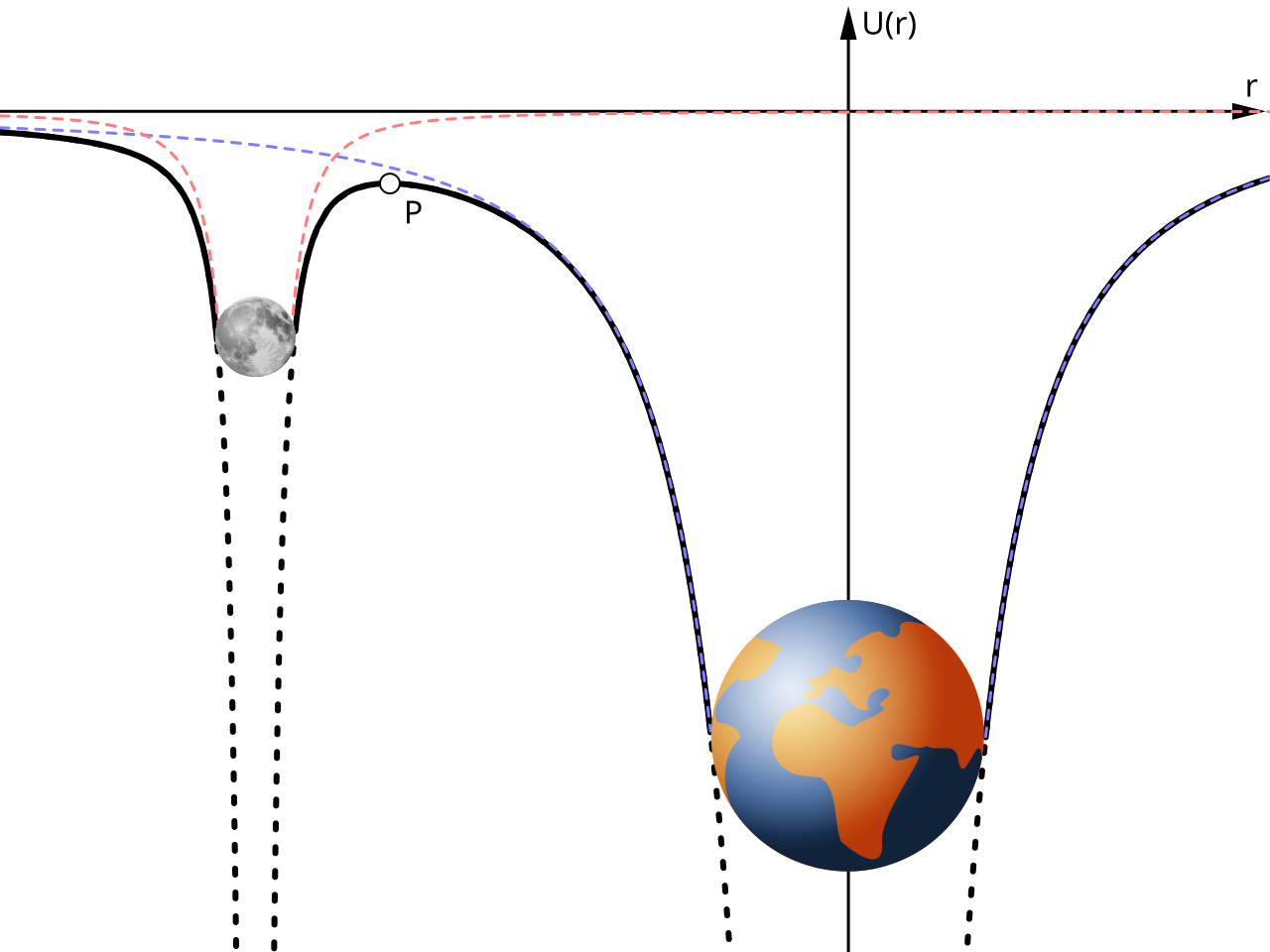
Gravitational potential energy represents the stored mechanical energy that any mass possesses simply by virtue of occupying a particular location within a gravitational field. It is a scalar quantity, carrying magnitude but no directional information, and it is intrinsically tied to the conservative character of the gravitational field. Physically, it quantifies the minimum amount of mechanical work an external agent must perform against the gravitational force to transport a mass from a chosen reference point—conventionally set at an infinite distance from the source mass—to some other location within the field. A key behavioral feature is that this energy grows as two masses are separated further apart, and it is released as kinetic energy when those masses are permitted to fall toward one another. The change in potential energy between two positions is precisely equal to the change in the kinetic energies of the objects as they accelerate under mutual gravitational attraction. This energy bookkeeping underpins countless physical processes, from orbital mechanics to the simple act of an object dropping to the ground.
The Work-Integral Formulation for Two Point Masses
The formal mathematical definition of gravitational potential energy for two point particles in mutual interaction rests on the concept of quasi-static work. Specifically, U equals the negative of the work performed by the gravitational field itself, which is equivalent to the work an outside agent must supply to slowly bring the two masses together without imparting any net kinetic energy. This is expressed as the negative line integral of the gravitational force vector dotted with the infinitesimal displacement vector of the mass. The scalar product between force and displacement ensures that only the component of force aligned with the direction of motion contributes to the energy transfer. Because the gravitational force is conservative, the resulting value depends solely on the initial and final positions, not on the particular path taken through space. The negative sign in the definition reflects the fact that the gravitational field does positive work as masses attract one another, so the external agent must perform work of opposite sign when the masses are brought closer together.
Newtonian Mechanics and the Negative Sign Convention
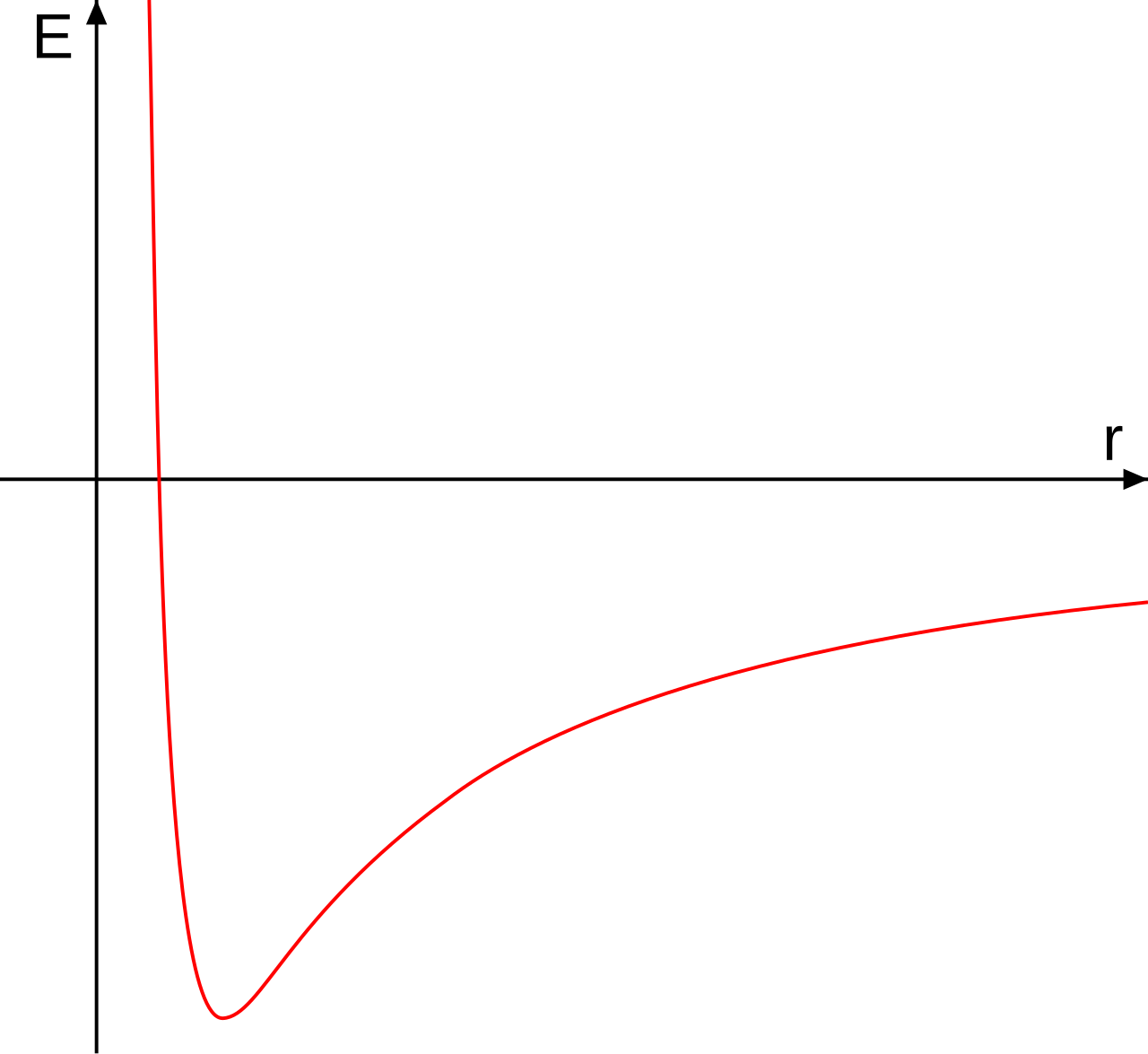
Within classical Newtonian mechanics, any collection of two or more masses necessarily possesses a gravitational potential energy, and the conservation of energy imposes a strict sign convention on this quantity. The gravitational field energy must always be negative, with the zero point defined at infinite separation between the interacting bodies. This convention ensures that as masses fall together, the potential energy becomes increasingly negative while kinetic energy rises, keeping total mechanical energy constant. The force governing this interaction follows Newton's law of universal gravitation: a point mass m experiences an attractive force directed toward a source mass M, with magnitude proportional to the product of the two masses and inversely proportional to the square of their separation. When one integrates this force along the radial path from infinity down to a finite distance R—such as the radius of the Earth—the total work done by gravity yields GMm over R. The gravitational potential energy, being the work required against this force, therefore equals the negative of that quantity, confirming the required negative sign.
The Near-Surface Approximation for Everyday Situations
In the everyday scenario where a comparatively small mass m moves in the vicinity of a vastly larger body of mass M—such as a person lifting a book near Earth's surface—the full inverse-square expression can be greatly simplified. Because the height change h is negligible relative to the radius R of the large body, the gravitational field strength remains essentially constant over that small interval. Under this approximation, the change in gravitational potential energy between the surface (a distance R from the center) and a point at height h above it reduces to a much simpler linear expression rather than the full reciprocal-distance formula. This is the familiar mgh relationship that appears in introductory physics courses. The simplification is valid precisely because the variation in the inverse-square force over a small height h compared to R is negligible, making the field effectively uniform. This approximation captures the essential physics of lifting and dropping objects in terrestrial settings while discarding the complexity of the general two-body formulation, and it remains the workhorse expression for engineering and everyday mechanical calculations.
Gallery
Frequently Asked Questions
What is Gravitational potential?
In the Relativity And Gravitation canon, Gravitational potential is a scalar field that assigns a numerical value to every point in space, representing the work per kilogram required to bring a test mass from a chosen reference location to that point. It sits squarely within classical mechanics and potential theory.
What are Gravitational potential's key abilities or roles?
It encodes the inverse-square acceleration law and obeys the superposition principle, so the total potential from many masses is simply the sum of each individual contribution. It also serves as the direct classical analogue of electric potential, with mass standing in for charge.
How does Gravitational potential's story conclude?
Its arc ends where classical mechanics breaks down; in the full relativistic treatment, the simple scalar potential gives way to the tensorial metric of general relativity. It remains a perfectly valid approximation in weak-field, low-velocity regimes, though.
Why is Gravitational potential important to the series?
It provides the foundational bridge between Newtonian force descriptions and the broader language of potential theory, making it indispensable for understanding orbital mechanics and conservative fields. Without it, the superposition principle for extended mass distributions would lack a clean mathematical home.
How does Gravitational potential relate to the electric potential?
The two are structural twins: both are scalar fields defined by work per unit of their respective source quantity (mass or charge), and both obey the same inverse-square and superposition rules. The key distinction is that gravitational potential is always attractive in sign, whereas electric potential can be positive or negative.
More in Relativity And Gravitation 1-20
Spotted an error? Know more?
This is a living reference — every entry is fact-audited, and reader corrections feed straight into our audit queue. Suggest an edit · See this site's audit record