
Gravitational wave

LIGO/Virgo/NASA/Leo Singer/Axel Mellinger · CC BY 4.0
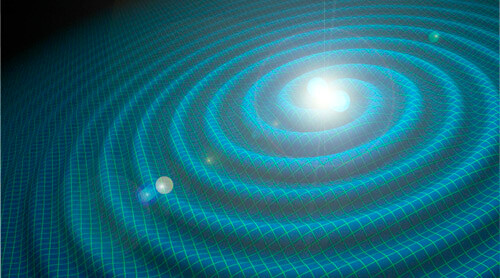
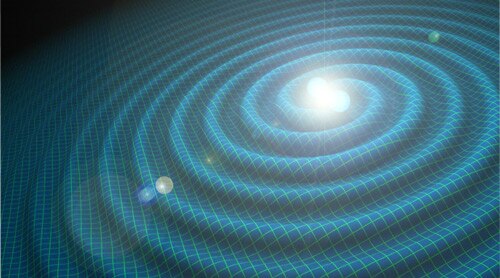
Gravitational waves are waves of spacetime curvature produced by the relative motion of gravitating masses, propagating away at the speed of light. First predicted by Albert Einstein as a consequence of his general theory of relativity, they appear as 'ripples in spacetime curvature' and transport energy as gravitational radiation, a form of radiant energy similar to electromagnetic radiation. Unlike Newtonian physics, which asserts instantaneous gravity, gravitational waves are a relativistic phenomenon absent from classical mechanics.
- first_predicted_by
- Albert Einstein
- speed
- equal to speed of light in vacuum
- key_observatories
- LIGO, Virgo, KAGRA
Lore & Background
In 1905, Henri Poincaré proposed gravitational waves as required by Lorentz transformations. Einstein published his general theory of relativity in 1915 and initially doubted his own wave solutions; Arthur Eddington in 1922 showed two of Einstein's three wave types were coordinate artifacts, though the transverse–transverse type always propagated at light speed.
Reader's Guide
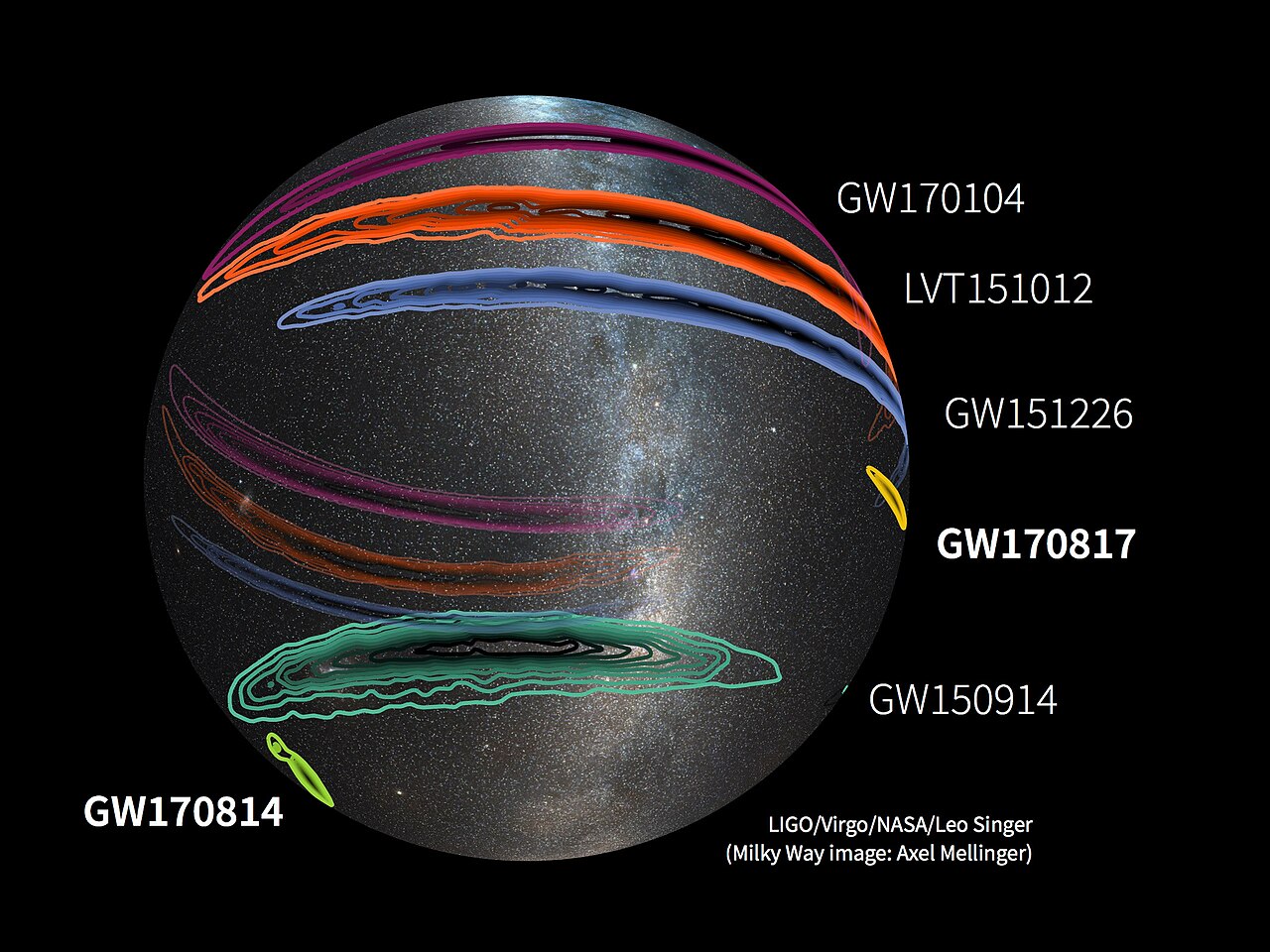
Gravitational waves have transformed astronomy by allowing observation of events invisible to electromagnetic telescopes, such as black hole mergers and the early universe shortly after the Big Bang. Because they do not strongly interact with intervening matter, they provide a direct view of exotic objects like binary neutron stars and supernovae. Ongoing observatories like Virgo and KAGRA, and future projects like LISA and the Einstein Telescope, promise to test general relativity more thoroughly and probe the universe's earliest moments, which are opaque to electromagnetic radiation.
Did You Know?
- Gravitational waves were first predicted by Albert Einstein as a consequence of his general theory of relativity.
The Relativistic Origin of Spacetime Ripples
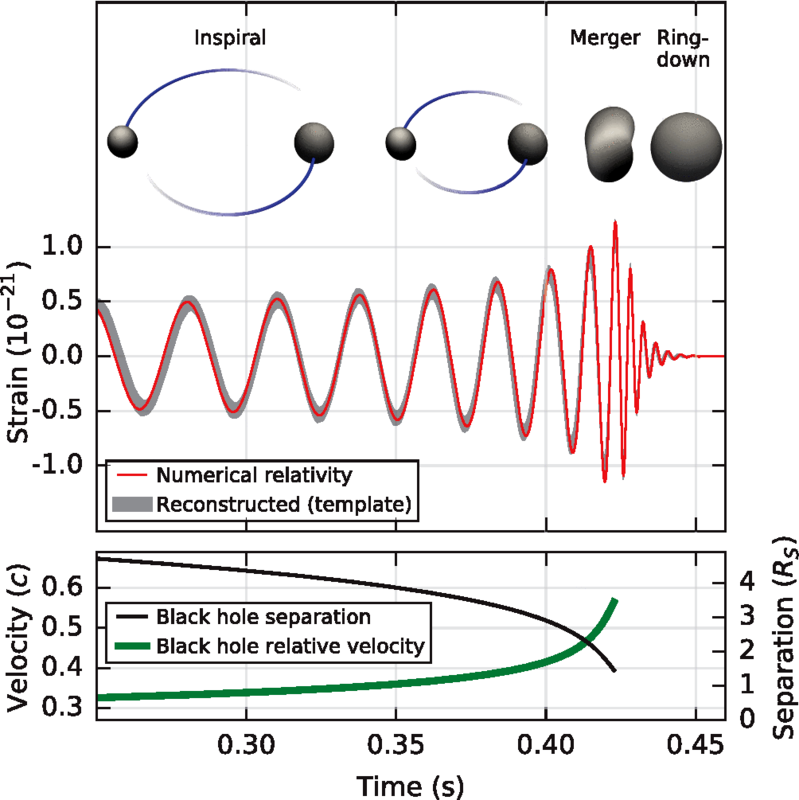
In Einstein's general theory of relativity, gravity is not a force pulling objects together but rather the geometric curvature of spacetime produced by the presence of mass. When those masses move in a non-spherically symmetric fashion, the local curvature changes, and the disturbance propagates outward as a gravitational wave traveling at the speed of light. This stands in sharp contrast to Newton's classical framework, where gravitational influence is instantaneous and no such radiative phenomenon exists. Gravitational waves therefore represent a purely relativistic effect, carrying energy away from their source as a form of gravitational radiation analogous to electromagnetic radiation. A wave passing through a region of space subtly stretches and compresses the distances between freely falling test masses, with the magnitude of that distortion falling off only as the inverse of distance rather than the inverse square. For the most energetic sources known—inspiraling binary neutron stars—the strain arriving at Earth is predicted to be less than one part in 10 to the 20th power, an extraordinarily tiny deformation that demands instruments of extraordinary precision to register.
From Pulsar Orbits to LIGO's Historic Chirp
The story of gravitational-wave detection spans four decades of increasingly precise measurement. Since that breakthrough, hundreds of gravitational-wave events have been catalogued. The Einstein Telescope and the space-based LISA mission are both in development, promising yet broader coverage of the sky and new frequency ranges.
A Window That Light Cannot Open
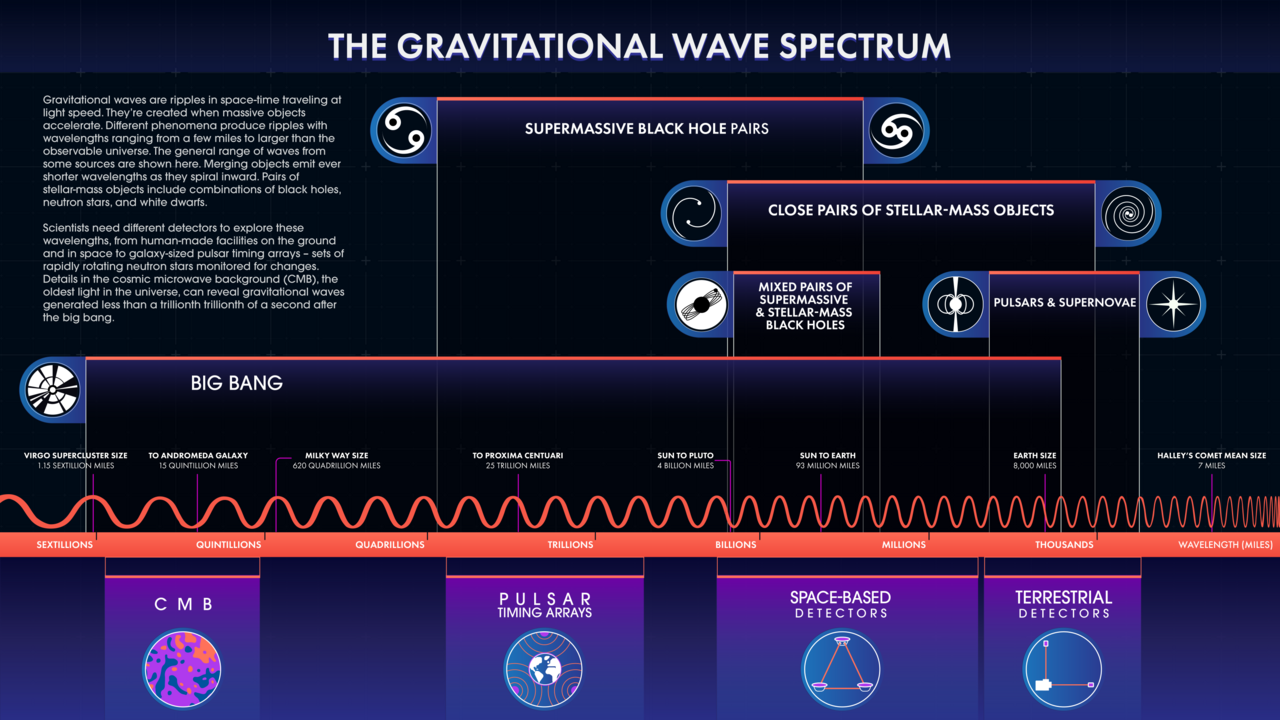
One of the most powerful advantages of gravitational-wave astronomy is that these waves pass through intervening matter essentially unimpeded, unlike electromagnetic radiation which is absorbed, scattered, or re-emitted by gas, dust, and plasma. This opens observational access to phenomena invisible to optical, radio, or X-ray telescopes. Binary systems of white dwarfs, neutron stars, and black holes can be studied in their final inspiral; supernova explosions can be probed from within; and, most remarkably, the universe in its first moments after the Big Bang becomes reachable. Before recombination, the early cosmos was opaque to photons, making conventional astronomy blind to that era. Gravitational waves, however, carry information from that primordial period unobstructed. In principle these waves can exist at any frequency, and very low-frequency signals—generated by mergers of supermassive black holes with wavelengths spanning light-years—can be detected through pulsar timing arrays that monitor roughly one hundred pulsars across the Milky Way over many years. Stephen Hawking and Werner Israel outlined plausible detection bands from 10 to the minus 7th hertz up to 10 to the 11th hertz, and astronomers have already identified the collective hum of numerous supermassive black-hole mergers throughout the universe.
The Universal Speed Limit and Multi-Messenger Astronomy
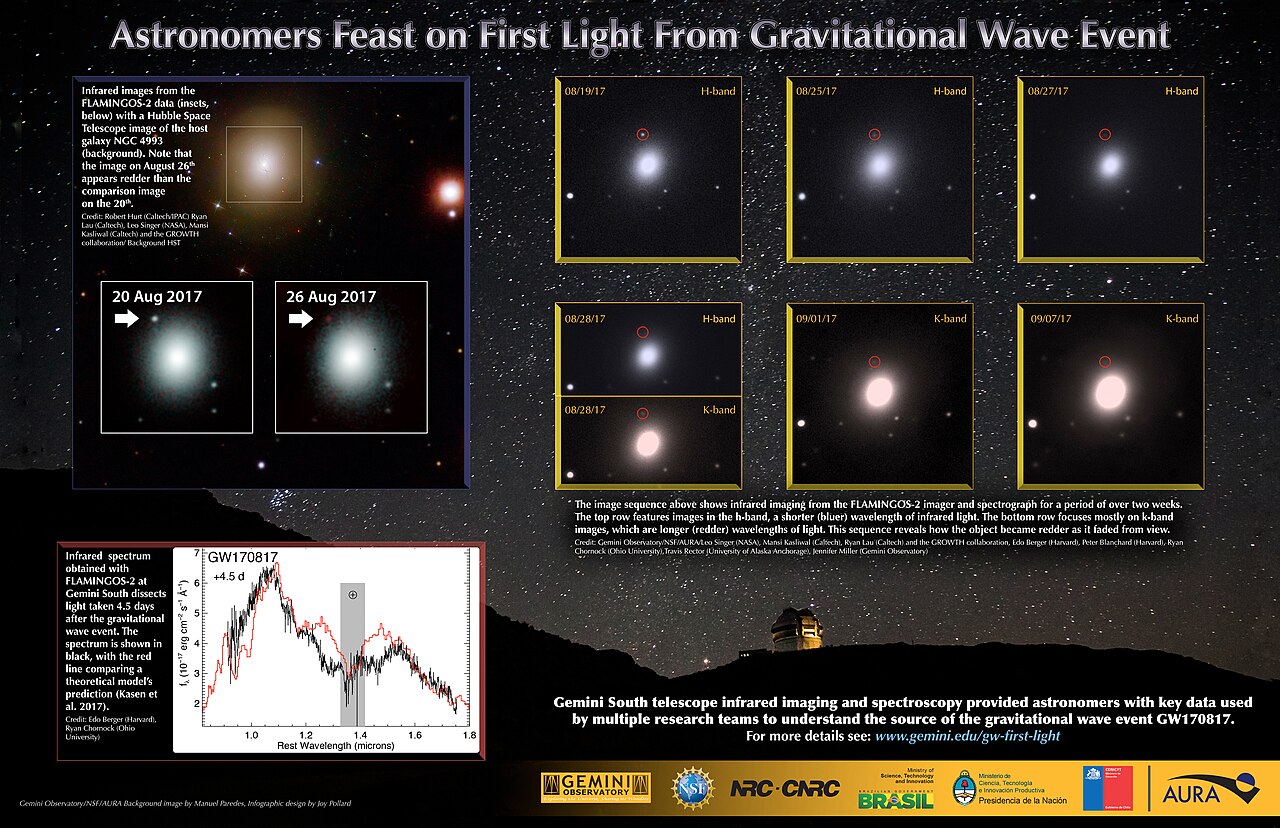
Within general relativity, gravitational waves propagate at exactly the same speed as light in vacuum—the constant c. In the broader framework of special relativity, c is not merely the speed of photons; it is the maximum speed at which any interaction in nature can occur, a fundamental conversion factor between units of time and units of space. Because it is independent of the motion of either the source or the observer, c sets the ceiling for all massless particles, including the gluon that mediates the strong nuclear force, the photon that carries electromagnetic force, and the hypothetical graviton, the presumed quantum field particle of gravity whose full description awaits a theory of quantum gravity that does not yet exist. That near-simultaneous arrival confirmed that gravitational waves and light travel at the same velocity, inaugurating the era of multi-messenger astronomy in which a single cataclysmic event can be observed through both gravitational and electromagnetic channels.
Gallery
Frequently Asked Questions
Who first predicted Gravitational waves?
Albert Einstein derived their existence as a natural consequence of his general theory of relativity, describing them as oscillating distortions in the geometry of spacetime. They have no counterpart in Newton's framework, where gravitational influence was assumed to act instantaneously across any distance.
What are Gravitational waves?
They are propagating disturbances in spacetime curvature generated when massive objects accelerate relative to one another, carrying energy outward at light speed in a manner analogous to electromagnetic radiation. They are a purely relativistic phenomenon with no analogue in classical Newtonian mechanics.
How fast do Gravitational waves travel?
They propagate at exactly the speed of light in vacuum, so no information they carry can outrun a photon. This finite propagation speed is a key departure from Newtonian gravity, which treated gravitational effects as instantaneous.
More in Relativity And Gravitation 1-20
Spotted an error? Know more?
This is a living reference — every entry is fact-audited, and reader corrections feed straight into our audit queue. Suggest an edit · See this site's audit record