
Energy–momentum relation
Relativistic equation linking energy, mass, and momentum.

Pietro Blaserna · Public domain
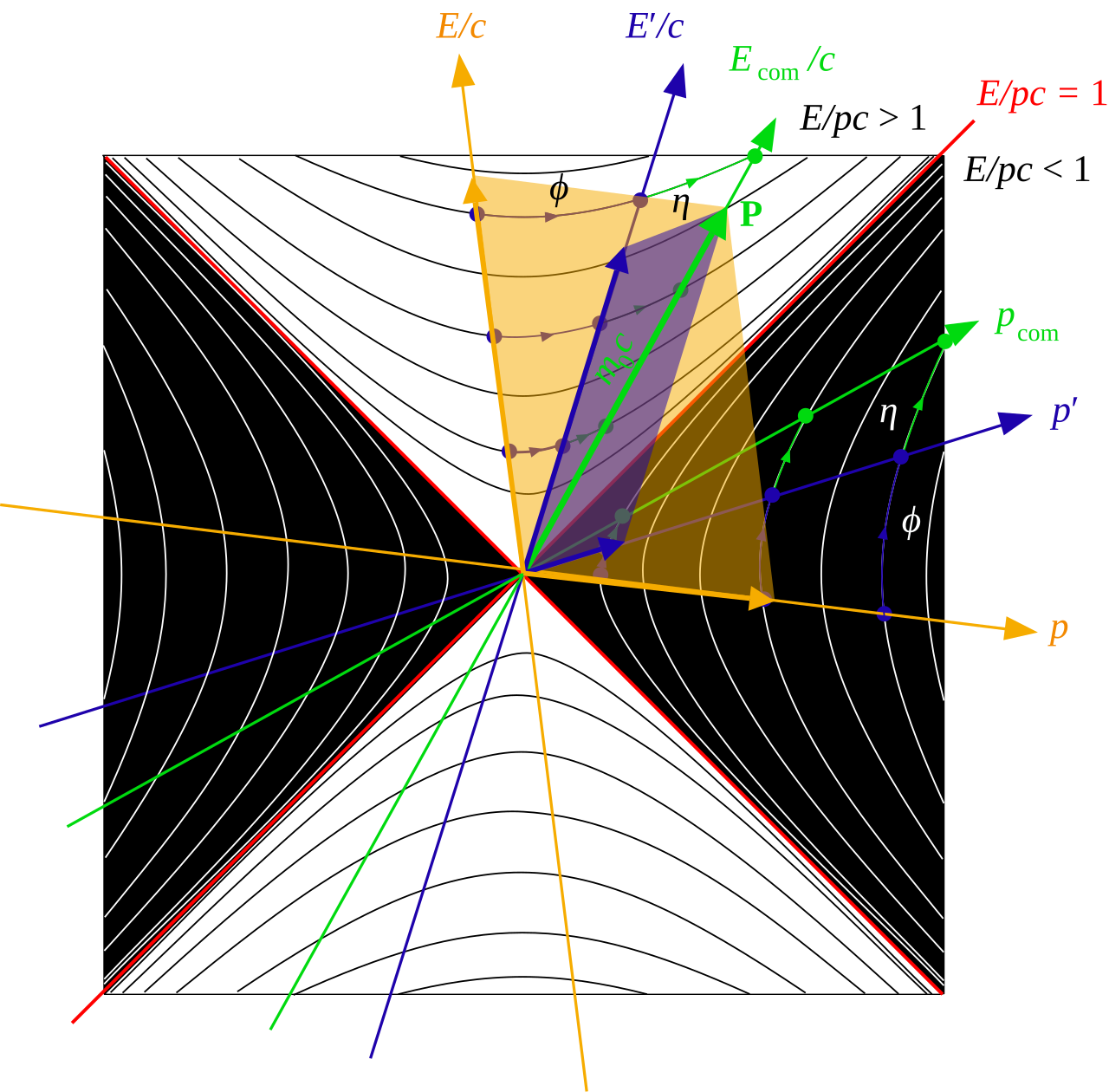
The energy–momentum relation, also known as the relativistic dispersion relation, is a fundamental equation in physics that relates total energy to invariant mass and momentum. It extends mass–energy equivalence to bodies or systems with non-zero momentum, assuming special relativity in flat spacetime and free particles.
- field
- Physics
- known_for
- Relativistic equation relating total energy, mass, and momentum
- related_concepts
- Mass–energy equivalence, Dirac sea model, four-momentum
Lore & Background
The Dirac sea model, which was used to predict the existence of antimatter, is closely related to the energy–momentum relation.
Reader's Guide
The energy–momentum relation is significant because it unifies energy and momentum within special relativity, providing a framework for understanding both massive and massless particles. It can be derived by considering the relativistic dynamics of a massive particle or by evaluating the norm of the four-momentum, a Lorentz invariant quantity. The equation holds for a body or system with total energy E, mass m, and momentum magnitude p, with c as the speed of light. Its legacy includes enabling the prediction of antimatter through the Dirac sea model and serving as a cornerstone for relativistic quantum mechanics. The relation is expressed as E² = (pc)² + (mc²)², and total energy is the sum of rest energy E₀ = mc² and relativistic kinetic energy.
Did You Know?
- The Dirac sea model, used to predict antimatter, is closely related to the energy–momentum relation.
- The equation can be derived by evaluating the norm of the four-momentum, which is a Lorentz invariant quantity.
Defining the Relativistic Energy–Momentum Link
The energy–momentum relation, sometimes called the relativistic dispersion relation, sits at the heart of special relativity by tying together three fundamental quantities: total energy, invariant (rest) mass, and the magnitude of momentum. It generalizes Einstein's famous mass–energy equivalence to situations where a body or system is actually moving, carrying non-zero momentum. In flat spacetime, for free particles, the equation states that total energy equals the square root of the sum of (pc)² and (mc²)², where c is the speed of light. The total energy itself decomposes into two parts: the rest energy mc² and the relativistic kinetic energy, which is what remains after subtracting the rest contribution. This framework applies not only to single particles but also to multi-particle systems, making it a cornerstone of relativistic mechanics.
Historical Roots and the Path to Modern Form
This version, E = √(c²p² + (mc²)²) + V, shows how the equation naturally accommodates forces beyond the free-particle case. The relation can be derived through several routes. One straightforward path examines the relativistic dynamics of a massive particle directly. Another, arguably more elegant, approach evaluates the norm of the four-momentum vector; this method works seamlessly for both massive and massless particles and extends to multi-particle systems with only modest additional effort.
A Heuristic Walkthrough for Massive Particles
For a massive object cruising at speed v in a laboratory frame, the total energy takes the form E = γmc², while the three-dimensional relativistic momentum has magnitude p = γmv. Both expressions contain the Lorentz factor γ = 1/√(1 − (v/c)²), which encodes the relativistic correction that grows without bound as v approaches c. A clean derivation begins by squaring the momentum expression to isolate v², then substituting that result back into the Lorentz factor to rewrite γ purely in terms of momentum and mass: γ = √(1 + (p/mc)²). Plugging this momentum-based form of γ into the energy equation yields E = mc²√(1 + (p/mc)²). Squaring both sides and rearranging produces the iconic relation E² = (pc)² + (mc²)². This heuristic route, though limited to massive particles, offers an intuitive bridge from classical velocity-based thinking to the fully relativistic energy–momentum framework.
Antimatter, the Dirac Sea, and Broader Reach
The energy–momentum relation is not merely a bookkeeping identity for particle mechanics; it is deeply entangled with one of the twentieth century's most dramatic predictions. The Dirac sea model, which was used to predict the existence of antimatter, is closely related to this equation. Beyond single free particles, the four-momentum norm derivation of the relation extends naturally to massless particles and to systems comprising multiple particles, requiring only modest additional effort. This universality—spanning massless and massive quanta as well as composite multi-particle systems—underscores why the equation remains a foundational tool in relativistic physics, connecting the rest-mass concept to the full spectrum of relativistic dynamics in flat spacetime.
Gallery

Frequently Asked Questions
What is the energy–momentum relation?
It is the relativistic equation that ties a particle's total energy to its invariant mass and its momentum. Think of it as the full, moving-object version of the famous E=mc² formula.
How does the energy–momentum relation connect to mass–energy equivalence?
E=mc² is simply the zero-momentum special case of the broader relation. Once a body carries non-zero momentum, the extra term in the equation accounts for its kinetic contribution to total energy.
What assumptions does the energy–momentum relation rely on?
It presumes flat spacetime and that the particle or system is free, meaning no external forces act on it. Those constraints keep it firmly in the special-relativity regime rather than the curved-spacetime world of general relativity.
Which other concepts does the energy–momentum relation link to?
It is a natural companion to four-momentum in the relativistic toolkit and also surfaces in discussions of the Dirac sea model. Both connections matter most when you move into relativistic quantum mechanics.
Why do fans and physicists keep coming back to the energy–momentum relation?
It is the single compact equation that unifies energy, mass, and motion under special relativity, making it a cornerstone for particle physics and beyond. Without it, you simply cannot describe a moving relativistic system in a consistent way.
More in Relativity And Gravitation 1-20
Spotted an error? Know more?
This is a living reference — every entry is fact-audited, and reader corrections feed straight into our audit queue. Suggest an edit · See this site's audit record