
Gravitational field
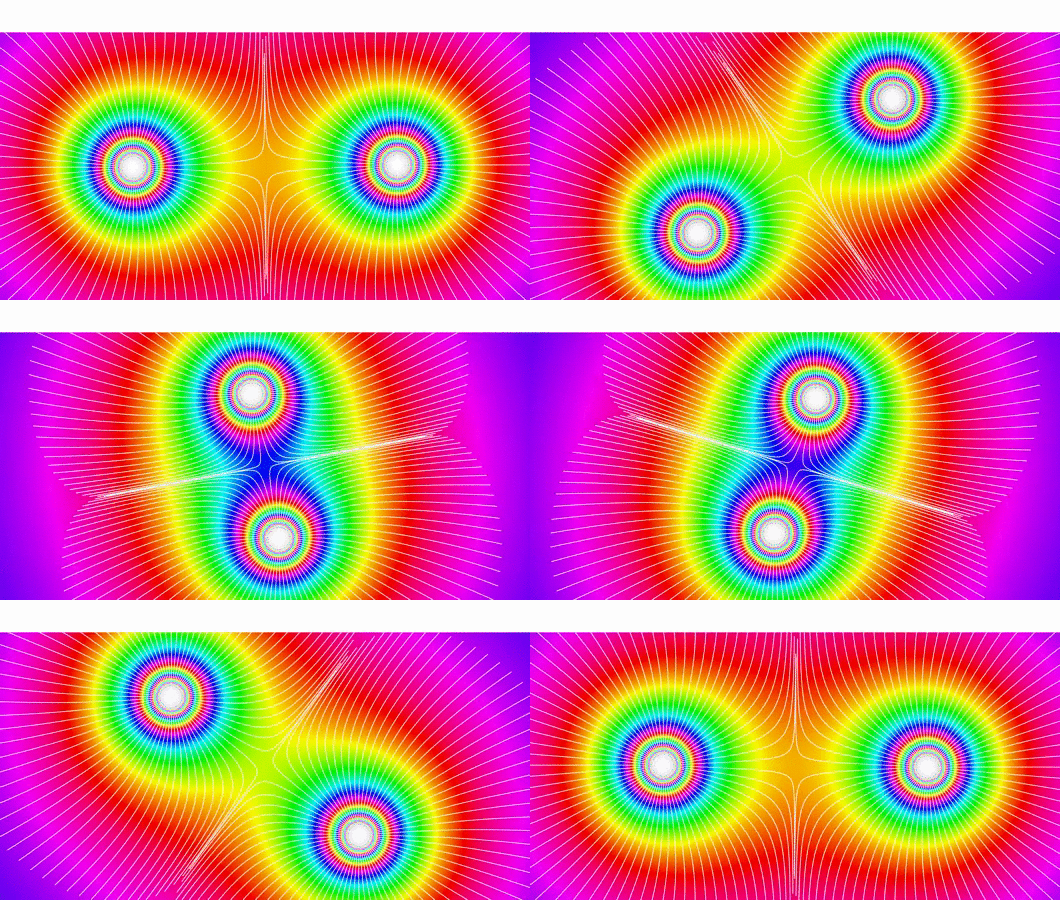
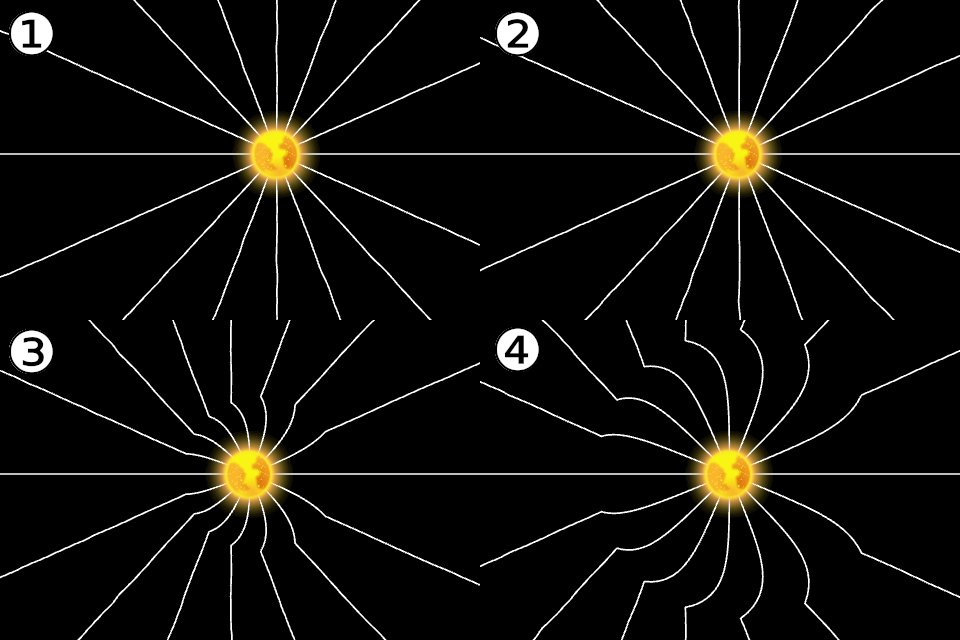
A vector field explaining gravitational influences around a body.

MikeRun · CC BY-SA 4.0
A gravitational field is a vector field used in physics to explain the influences that a body extends into the space around itself. It is used to explain gravitational phenomena, such as the gravitational force field exerted on another massive body. The field has dimension of acceleration (L/T²) and is measured in units of newtons per kilogram (N/kg) or, equivalently, in meters per second squared (m/s²).
- field
- Physics
- known_for
- Explaining gravitational phenomena as a vector field
- dimension
- Acceleration (L/T²)
- units
- Newtons per kilogram (N/kg) or meters per second squared (m/s²)
Lore & Background
In classical mechanics, a gravitational field is defined using Newton's law of universal gravitation. Around a single particle of mass M, the field g is a vector field pointing directly towards the particle, with magnitude representing the force per unit mass on any object at that point. The field is conservative, leading to a scalar gravitational potential Φ. The field equation includes Newton's law and the relation between potential and field acceleration, with negative signs because the force acts antiparallel to displacement. The field around multiple particles is the vector sum of individual fields.
Reader's Guide
The concept of a gravitational field is significant because it shifted explanations of gravity from point-mass forces to a field model, as developed since the 19th century. In classical mechanics, the field equations allow the motion of a test particle to be determined. In general relativity, gravity is not a force between particles but a distortion of spacetime by mass, perceived as a force. Gravity is distinguished from other forces by its obedience to the equivalence principle. The field's mathematical formulation includes Gauss's law and Poisson's equation for gravity, and in general relativity, the equations of motion involve Christoffel symbols and the metric tensor. This framework remains fundamental to understanding gravitational interactions.
Did You Know?
- A gravitational field has dimension of acceleration (L/T²) and is measured in newtons per kilogram (N/kg) or meters per second squared (m/s²).
- In classical mechanics, the gravitational field around a single particle is a vector field pointing directly towards the particle.
- In general relativity, particles distort spacetime via their mass, and this distortion is perceived as a force.
- The gravitational field equation includes Newton's law of universal gravitation and the relation between gravitational potential and field acceleration.
From Point Attraction to Field Thinking
The earliest conception of gravity treated it as a direct pull between point masses, with no intermediary medium or spatial structure involved. Building on Newton's framework, Pierre-Simon Laplace later proposed modeling gravity as a kind of radiation field or fluid, introducing the idea that something propagates through space to mediate the interaction. By the nineteenth century, the dominant pedagogical approach in classical mechanics had shifted decisively toward a field model, replacing the older notion of instantaneous point-to-point attraction. In this modern classical picture, a gravitational field is a vector field that characterizes the influence a body exerts throughout the space surrounding it. It carries the dimension of acceleration, expressed in newtons per kilogram or, equivalently, meters per second squared, and it arises mathematically as the spatial gradient of a scalar gravitational potential. This reconceptualization—from action at a distance to a local, spatially distributed quantity—remains one of the most consequential shifts in how physicists describe gravitational interaction.
The Classical Mathematical Framework
Within classical mechanics, the gravitational field g surrounding a single mass M is a vector field in which every point in space carries a vector directed straight toward that mass. The magnitude at any given point quantifies the force per unit mass that a test object would feel there. Because the field is conservative, a scalar gravitational potential Φ is defined at each point, and the field itself is the negative spatial gradient of that potential. The formulation naturally yields Gauss's law for gravity and Poisson's equation, both tying the field to the local mass density ρ. Notably, Newton's law implies Gauss's law, though the converse does not hold. When several masses are present, the total field is obtained by a straightforward vector sum of the individual contributions—a direct superposition principle. Together, these differential equations of motion provide a complete toolkit for setting up and solving the trajectory of a test particle moving under gravitational influence.
The General Relativity Reinterpretation
General relativity upends the classical force picture entirely. Instead of two particles exerting an attractive force on one another, massive bodies warp the geometry of spacetime, and it is this curvature that observers perceive and quantify as a gravitational effect. Matter follows particular paths in response to the shape of spacetime, and within this framework gravity is either absent as a genuine force or reclassified as a fictitious, inertial-like effect. This geometric interpretation stands in sharp contrast to the classical view of a real, measurable force acting across space. Gravity is further set apart from every other fundamental interaction by its strict obedience to the equivalence principle, a property no other force possesses. In the relativistic picture, what classical mechanics calls a gravitational field is not a force field in the traditional sense at all but a manifestation of spacetime geometry sculpted by the presence of mass.
The Test-Particle Picture and Physical Meaning
At its core, the gravitational field is defined as force per unit mass: g equals F divided by m. This definition endows it with the dimension of acceleration, measured in newtons per kilogram or meters per second squared. In practice, the field at any location in space tells you precisely what acceleration a small test particle would acquire if placed at that spot. The negative sign appearing in the field equation reflects the fact that the gravitational force always acts antiparallel to the displacement vector, drawing objects inward toward the source. The radial vector R encodes the test particle's position relative to the attracting mass, and the field magnitude scales with the inverse cube of the distance once the radial direction is accounted for. The expression d²R/dt² equals both F/m and the gravitational acceleration g, unifying the inertial and gravitational descriptions into a single mathematical statement. This test-particle framework makes the gravitational field an extraordinarily practical instrument for predicting motion in any gravitational configuration.
Gallery
Frequently Asked Questions
Who is Gravitational field?
Gravitational field is a vector field in physics that describes how a massive body exerts influence on the surrounding space. It is the conceptual tool we use to map out where and how strongly gravity reaches beyond a given object.
What are Gravitational field's powers or role?
Its core role is to explain gravitational phenomena by representing the force a body exerts on other massive objects in its vicinity. Rather than treating gravity as an instantaneous pull, the field concept lets us picture a continuous influence spread through space.
How does Gravitational field's story end?
As a foundational entry in the Relativity And Gravitation 1-20 series, it sets the stage for later concepts rather than concluding a narrative arc. Its 'ending' is really its handoff to more advanced frameworks, such as general relativity, where the notion of a force field gives way to spacetime curvature.
Why is Gravitational field important?
It provides the simplest quantitative language for describing how mass shapes the space around it, making otherwise invisible forces measurable and predictable. Without this vector-field picture, calculating the acceleration a satellite or falling object experiences would lack a clear, local description.
What units and dimension does Gravitational field carry?
The field carries the dimension of acceleration, expressed as length over time squared (L/T²). In practice it is reported in newtons per kilogram (N/kg), which is numerically identical to meters per second squared (m/s²).
More in Relativity And Gravitation 1-20
Spotted an error? Know more?
This is a living reference — every entry is fact-audited, and reader corrections feed straight into our audit queue. Suggest an edit · See this site's audit record