
Geodesics in general relativity
Geodesics describe the paths of freely falling particles in curved spacetime.

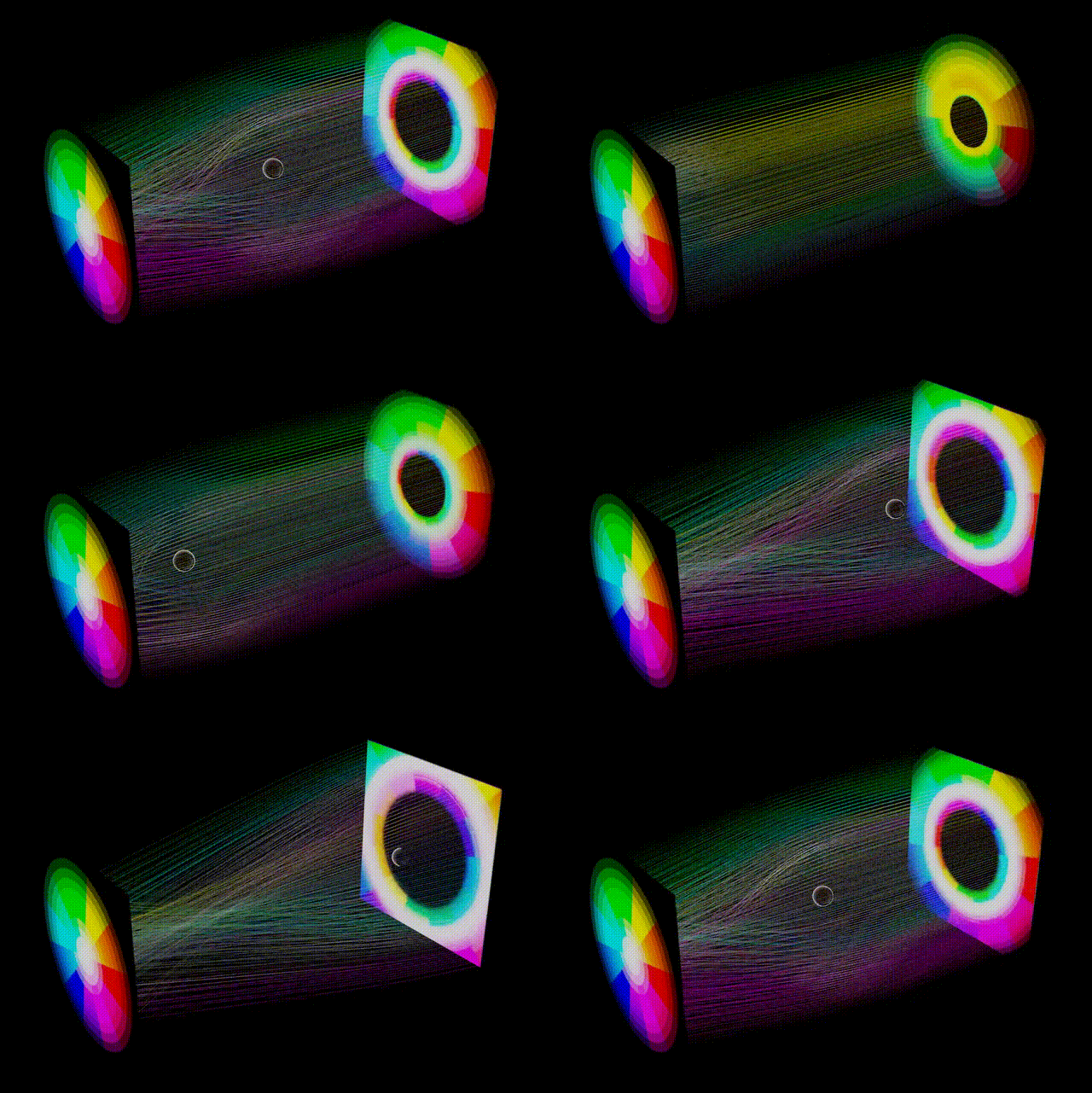
In general relativity, a geodesic generalizes the notion of a straight line to curved spacetime. The world line of a particle free from all external, non-gravitational forces is a particular type of geodesic, meaning a freely moving or falling particle always moves along a geodesic. Gravity is regarded not as a force but as a consequence of curved spacetime geometry, where the source of curvature is the stress–energy tensor.
- field
- General relativity
- known_for
- Geodesic equation of motion, generalization of straight lines to curved spacetime
- concept_type
- Mathematical and physical concept
Lore & Background
The geodesic equation is mathematically expressed as d²xᵐ/ds² + Γᵐ_αβ (dxᵃ/ds)(dxᵝ/ds) = 0, where s is a scalar parameter such as proper time, and Γᵐ_αβ are Christoffel symbols symmetric in the two lower indices. Greek indices take values 0, 1, 2, 3, and the summation convention is used for repeated indices. The left-hand side represents the acceleration of a particle, making the equation analogous to Newton's laws of motion. The Christoffel symbols are functions of the four spacetime coordinates and are independent of the velocity or acceleration of the test particle.
Reader's Guide
The geodesic equation can also be written using coordinate time t ≡ x⁰, yielding a form useful for computer calculations and for comparing general relativity with Newtonian gravity. When the particle's velocity is small, the geodesic equation reduces to d²xⁿ/dt² = –Γⁿ_₀₀, meaning all test particles at a particular place and time have the same acceleration, a well-known feature of Newtonian gravity. Physicist Steven Weinberg presented a derivation of the geodesic equation directly from the equivalence principle, starting with the assumption that a free-falling particle does not accelerate in the neighborhood of a point-event with respect to a freely falling coordinate system. The geodesic concept is central to understanding how gravity shapes the motion of objects, from planets orbiting stars to objects floating in the International Space Station.
Did You Know?
- The geodesic equation is analogous to Newton's laws of motion, providing a formula for the acceleration of a particle.
- The Christoffel symbols in the geodesic equation are independent of the velocity or acceleration of the test particle.
- When the particle's velocity is small, the geodesic equation reduces to d²xⁿ/dt² = –Γⁿ_₀₀, implying all test particles at a given place and time have the same acceleration.
- Physicist Steven Weinberg derived the geodesic equation directly from the equivalence principle.
From Force to Geometry: The Newtonian to Einsteinian Shift
For over two centuries, the scientific community relied on Newton's picture of gravity: a mutual attractive force pulling massive objects toward one another. That framework proved extraordinarily successful at tracking planetary motion, yet even Newton himself felt uneasy about the mysterious nature of the force he had merely described. By the early 1900s a deeper problem emerged. Einstein's 1905 special relativity had redefined space and time in ways that made Newton's gravitational law fundamentally incompatible with the new physics. Several researchers attempted to patch the two theories together, but only Einstein's own extended work, carried out between 1907 and 1915, produced a description consistent with both the relativistic framework and experimental data. In his formulation, gravity is no longer a force acting across space; instead, masses warp the geometry of spacetime itself, and what we perceive as gravitational attraction is the natural consequence of objects moving through that curved geometry. This geometric picture also explained stubborn anomalies, such as the small irregularities in Mercury's orbit, that Newton's equations could not account for.
The Free-Fall Elevator and the Equivalence Principle
Einstein's most powerful starting point came from a deceptively simple thought experiment. Imagine a person inside an elevator that is in free fall. Because the person, the cabin, and every object within it are all accelerating downward at the same rate, nothing appears to fall. A pen released from the hand simply hovers; a ball drifts at a steady speed. No experiment conducted inside that cabin could reveal the presence of gravity. The situation is, in every observable respect, identical to floating in deep space, far from any massive body. Those deep-space observers are precisely the inertial observers of special relativity, for whom light travels in straight lines at a constant speed. Einstein took this equivalence not as a coincidence but as a fundamental property of gravity itself. He elevated it to the cornerstone of his new theory, formalizing it as the equivalence principle: every measurement performed in a freely falling frame yields the same result as it would for an observer at rest or in uniform motion in empty space. This single idea became the seed from which the entire geometric theory of gravitation grew.
Gravity as a Fictitious Force
The equivalence principle carries a striking corollary. While the familiar effects of gravity disappear for a freely falling observer, the reverse is equally true: an accelerated frame of reference can manufacture effects indistinguishable from gravity. Picture a sealed room. In one scenario the room sits on Earth's surface and objects drop to the floor because of gravity. In the other, the room is a rocket drifting through empty space, accelerating upward at 9.81 metres per second squared, and objects press against the floor because of the same inertial force that shoves a car driver into their seat. The occupant cannot tell which situation they are in. Einstein's master insight was to declare that the constant pull we attribute to Earth's gravity is, at a fundamental level, the same kind of fictitious force that appears in any accelerated frame. Crucially, the magnitude of these fictitious forces is always proportional to the mass of the object experiencing them, exactly as Newton's law of gravitation requires. This proportionality linked the everyday sensation of weight to the deeper geometry of spacetime.
Predictions, Black Holes, and the Quantum Frontier
Even eight years before the full theory was complete, Einstein's equivalence principle already yielded concrete, testable predictions. By 1907 he could foresee phenomena that Newton's framework had no mechanism to produce: the bending of light by massive bodies, the slowing of time in a gravitational field, and the propagation of ripples through spacetime known as gravitational waves. Many of these predictions have since been confirmed by observation, with gravitational waves representing the most recent triumph. The theory's reach extends far beyond solar-system tests. It underpins the modern understanding of black holes, regions where gravity is so intense that not even light can escape, and it explains the violent radiation emitted by active galactic nuclei and microquasars. General relativity also anchors the standard Big Bang model of cosmology. Yet the most profound open question remains: how to reconcile this classical geometric theory with the quantum laws that govern the microscopic world, ultimately producing a self-consistent theory of quantum gravity.
Gallery
Frequently Asked Questions
What is Geodesics in general relativity?
It is a mathematical and physical concept within the field of general relativity that extends the everyday idea of a straight line into the curved geometry of spacetime. The concept is best known for the geodesic equation of motion.
What role do Geodesics in general relativity play?
They define the natural trajectories that freely falling particles follow when no non-gravitational forces act on them. In this picture, gravity is not a force at all but the geometric effect of spacetime curvature sourced by the stress-energy tensor.
Why is Geodesics in general relativity important?
It supplies the core rule for how matter moves in Einstein's theory, replacing the Newtonian notion of a gravitational pull with pure geometry. Without the geodesic framework, the prediction that free-fall motion is dictated solely by spacetime shape would lack a mathematical expression.
How does Geodesics in general relativity's story end?
As a concept it has no narrative conclusion, but physically a geodesic path persists until the particle encounters a non-gravitational interaction or reaches a singularity where the classical description ceases to apply.
What are Geodesics in general relativity's key features?
The central feature is the geodesic equation of motion, which encodes how spacetime curvature steers a particle's trajectory. It generalizes the familiar straight-line idea so that motion in curved spacetime follows the 'straightest' path the geometry permits.
More in Relativity And Gravitation 1-20
Spotted an error? Know more?
This is a living reference — every entry is fact-audited, and reader corrections feed straight into our audit queue. Suggest an edit · See this site's audit record